
Americans eat nearly 3 billion pounds of avocados every year, yet most of us still rely on a single, unreliable test to pick them: the squeeze. If that's your only move, you're getting it wrong roughly 40% of the time — ending up with either rock-hard fruit that won't ripen for days or brown, stringy mush that goes straight to the compost bin.
The good news? Picking a perfectly ripe avocado is a learnable skill, and it only takes about 10 seconds once you know the method. In this guide, we'll cover the three-step system that professional produce buyers use, what the science says about avocado ripening, and how AI-powered tools like PluckFresh's produce freshness scanner are making the guesswork disappear entirely.
Why the Squeeze Test Alone Doesn't Work
The classic advice is simple: if the avocado yields to gentle pressure, it's ripe. The problem is that firmness tells you very little about what's happening inside. An avocado can feel "just right" on the outside while hiding dark, oxidized spots beneath the skin. Conversely, a slightly firm avocado might be perfect for tomorrow's guacamole but gets passed over at the store.
Worse, every squeeze from every shopper bruises the fruit. Those brown spots you find when you cut open a "perfectly ripe" avocado? Those are often bruises from the 15 people who squeezed it before you.
The Three-Step Method: Color, Feel, Stem
Professional produce buyers and experienced chefs use a three-signal approach. No single test is definitive — but together, they're accurate over 90% of the time.
Step 1: Color Check
For Hass avocados (the most common variety in American supermarkets), color is your first filter:
- Bright green — 4–5 days from ripe. Buy these if you're planning ahead.
- Green with dark patches — 2–3 days out. Good "buy ahead" territory.
- Dark purplish-green all over — ripe or very close. This is the sweet spot.
- Near-black — could be perfect or overripe. Use the next two tests to confirm.
Important: color alone only narrows the window. Green-skinned varieties like Fuerte or Reed don't change color much at all, which is why steps 2 and 3 matter.
Step 2: The Gentle Palm Test (Not a Squeeze)
Instead of pinching with your fingers (which causes bruising), place the avocado in your palm and apply gentle, even pressure with all five fingers. You're feeling for the overall firmness, not poking for soft spots.
- Hard, no give — not ripe. Come back in 3–5 days.
- Slight yield, springs back — ripe today or tomorrow. Perfect for buying.
- Soft, doesn't spring back — overripe or close to it. Only good if you're making guacamole right now.
Step 3: The Stem Test
This is the pro move most people skip. Flick or gently pry off the small, round stem cap at the top of the avocado:
- Comes off easily, green underneath — ripe and ready to eat.
- Comes off easily, brown underneath — overripe. Likely brown inside too.
- Doesn't come off easily — not yet ripe. Give it more time.
PluckFresh Tip
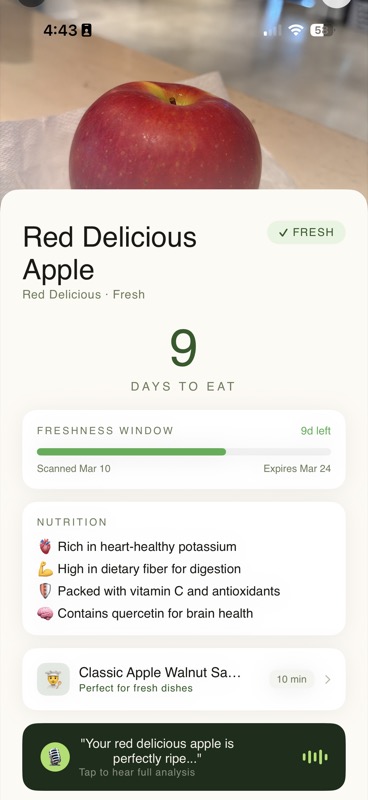
PluckFresh's AI produce freshness scanner analyzes surface color patterns, texture micro-variations, and visual ripeness cues that are invisible to the naked eye — delivering a freshness score in about 3 seconds. It's like having a produce expert in your pocket.
How to Ripen Avocados Faster (and Slower)
Once you've bought your avocados, timing is everything. Here's how to control the ripening process:
Speed Up Ripening
- Paper bag method: Place the avocado in a brown paper bag with a banana or apple. These fruits release ethylene gas, which accelerates ripening. Check daily — this typically cuts 1–2 days off the timeline.
- Rice method: Bury the avocado in uncooked rice in a bowl. The rice traps ethylene gas around the fruit. Check after 24 hours.
- Room temperature: Simply leave avocados on the counter, away from direct sunlight. Natural ripening takes 4–5 days for a firm avocado.
Slow Down Ripening
- Refrigerate when ripe: Once your avocado passes the three-step test, move it to the fridge. Cold temperatures slow ripening and give you 2–3 extra days.
- Store cut avocado properly: Keep the pit in the unused half, brush the exposed flesh with lemon or lime juice, wrap tightly in plastic wrap, and refrigerate. The acid and airtight seal slow oxidation (browning).
The Food Waste Problem: Why Getting This Right Matters
Americans throw away 30–40% of their food, and produce is the single largest category of waste. Avocados are especially vulnerable because their ripeness window is narrow — typically just 1–2 days of peak quality.
When you pick an avocado that's too far gone, it goes straight to the trash. When you pick one that's too firm and forget about it, same result. Getting the ripeness check right isn't just about better guacamole — it's one of the simplest ways to reduce household food waste.
The average American household wastes approximately $1,500 worth of food per year. Produce — especially short-window items like avocados, berries, and bananas — accounts for the largest share of that waste.
How AI Is Changing the Produce Aisle
The three-step method works well for experienced shoppers, but it still requires practice and subjective judgment. That's where technology comes in.
Computer vision and machine learning models — like the one powering PluckFresh — can analyze thousands of visual data points in a single image: color distribution, surface texture patterns, stem condition, and skin uniformity. These are the same signals produce professionals evaluate, but processed with consistency and speed that human judgment can't match.
With PluckFresh, you simply point your phone camera at the avocado (or any other produce), and the app returns:
- A freshness score on a clear, easy-to-read scale
- Estimated days remaining at peak freshness
- Storage recommendations specific to the current ripeness stage
- Recipe suggestions matched to how ripe the produce is right now
FAQ: Common Avocado Ripeness Questions
Can you eat a brown avocado?
Light brown streaks are usually fine — they're caused by vascular browning and don't affect taste. If the entire flesh is brown and mushy, it's past its prime and best composted.
Why are my avocados always brown inside?
The most common causes are bruising from over-squeezing at the store and buying overripe fruit. Use the stem test to catch brown interiors before buying, and switch to the palm test instead of finger-poking.
What's the best day to buy avocados for the weekend?
If you're shopping for Saturday guacamole, buy on Wednesday. Look for avocados that are transitioning from green to dark — they'll be perfect in 2–3 days at room temperature.
Do all avocado varieties ripen the same way?
No. Hass avocados change color as they ripen (green to purple-black), but varieties like Fuerte, Reed, and Bacon stay green. For green-skinned varieties, rely more heavily on the palm test and stem test.
Stop Guessing. Start Scanning.
PluckFresh's AI-powered produce freshness scanner tells you exactly when to eat your fruit and vegetables. Free for iOS.
Get Notified at Launch

